Camera blind spots
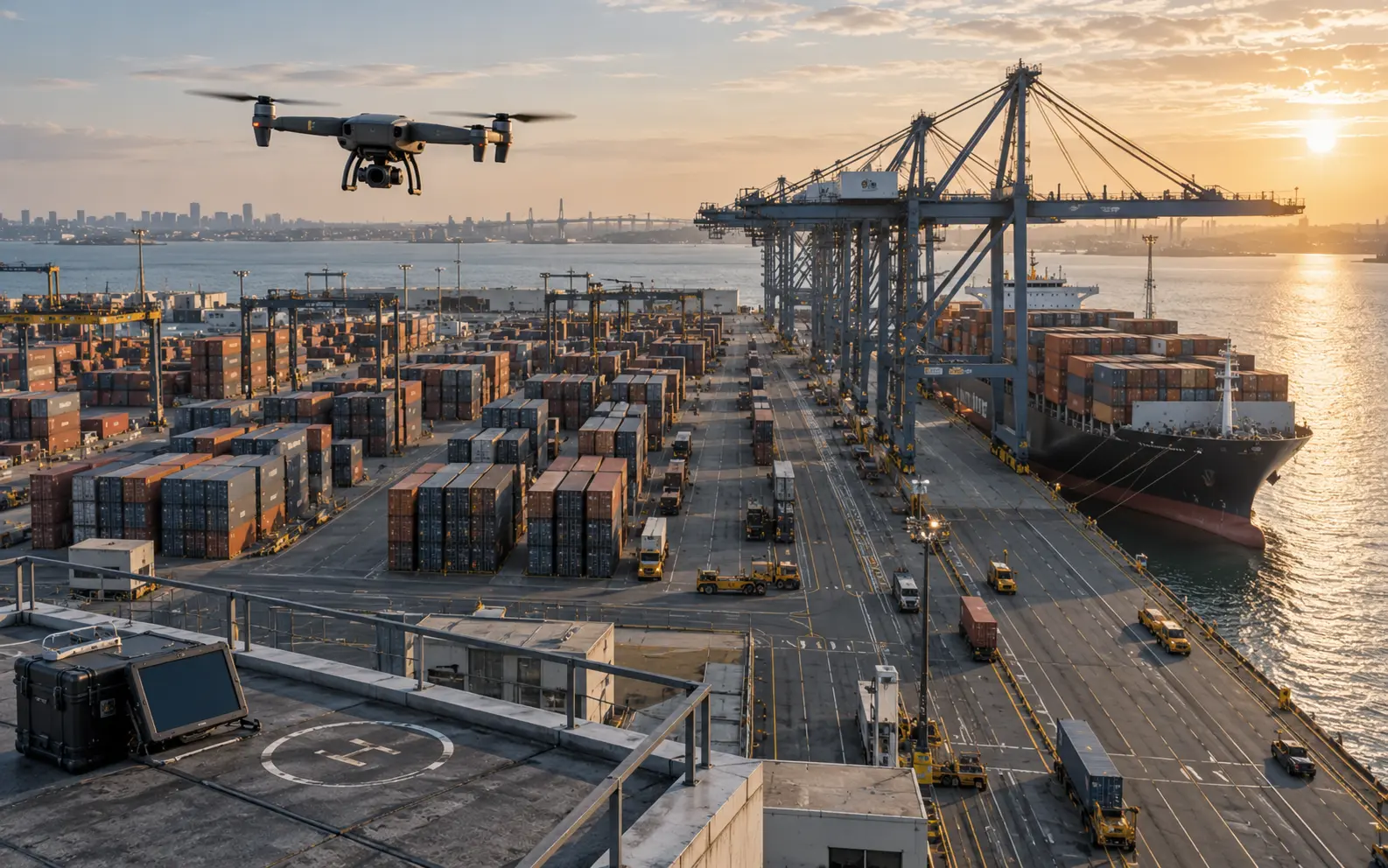
Operations / Site Intelligence Presence
See across the port. Respond where fixed infrastructure cannot.
A mobile intelligence presence that verifies alarms, observes vessels and yards, and connects aerial evidence to port security and operating systems.
See how it works06 / 09
01
The operational shift
Guard dispatch
Aerial verification
Separate feeds
Correlated evidence
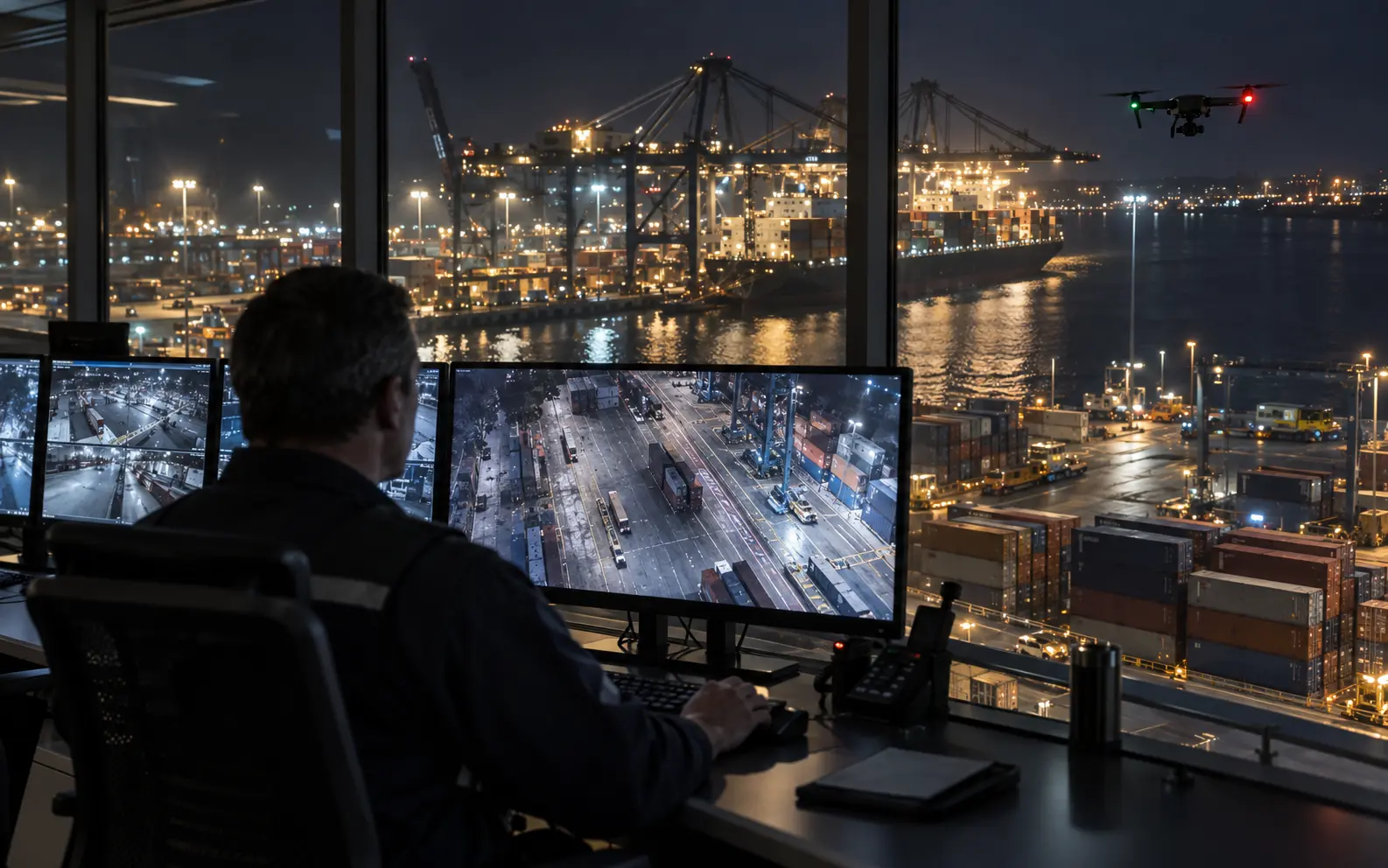
Presence in the workflow
One command view. Mobile visibility across the port.
Operations / Site Intelligence Presence02
What this presence does
Perimeter verification
Dispatches to alarms and distinguishes people, vehicles and environmental triggers.
Container yard visibility
Observes open doors, restricted-zone activity and changing yard conditions.
Vessel observation
Captures hull, deck, berthing and transfer activity for authorised operators.
Infrastructure inspection
Surveys cranes, roofs, piers and hard-to-reach structures for visible deterioration.
Congestion intelligence
Measures vehicle counts, dwell and bottlenecks at gates and operating zones.
Event response
Provides rapid site context after weather, fire, spill or security incidents.
Fly only inside the approved geofence and the flight envelope published for that shift. On a perimeter alarm, reach the point, classify the trigger as person, vehicle or environment, and report before a guard is dispatched. Observe vessels and yard zones only where the terminal operator has authorised it; stay clear of customs-controlled and berth-exclusion areas. Hand every confirmed intrusion, open container door or structural finding to the security controller with location, timestamp and clip attached. Return to dock and log the mission.
From the presence brief
03
How Ananta achieves it
One intelligence loop.
Built around the work.
- 01
Trigger
Start from schedule, operator request or connected alarm.
- 02
Dispatch
Select the safe route, payload and observation position.
- 03
Understand
Classify activity and correlate it with zone and operational context.
- 04
Coordinate
Send verified intelligence to security or operations.
- 05
Evidence
Retain the event timeline and media for review.
04
Deployment architecture
Ananta Presence Runtime
Connect the physical environment to enterprise action.
Field layer
Drone · Dock · Zoom/thermal payload · VMS · Perimeter sensors
Enterprise inputs
AIS · TOS · Access control · GIS · Incident management
Actions
Alarm verification · Patrol · Dispatch · Inspection · Incident package
Intelligence
Object/activity detection · Change analysis · Zone rules · Timeline correlation
05
Prove the value
Measure what changes.
- Alarm-to-visibility time
- Patrol coverage
- False dispatch avoided
- Asset inspection hours
- Incident evidence completeness
06
Enterprise controls
Governed from the start.
- Restricted-zone geofencingIncluded
- Operator authorisationIncluded
- Retention policiesIncluded
- Mission and evidence auditIncluded
07
Boundaries by design
- Never identifies a person by face, badge or gait; findings name zones, not individuals.
- Does not dispatch guards, open gates or hold a truck; the security controller decides.
- Does not copy AIS or TOS data; it reads them at mission time only.
- Never inspects cargo contents or enters customs-bonded areas; it observes doors, zones and movement.
08
Before you buy
Deployment questions.
What hardware goes on site?
One docked drone per coverage zone, with a zoom and thermal payload, plus power and network at the dock. It connects to your existing VMS, perimeter sensors and access control; no new cameras or poles.
Who approves a flight?
Scheduled patrols and alarm responses run inside a geofence and flight envelope the port authority signs off in advance. Anything outside that envelope needs a named security controller to approve from the console, and every approval is logged.
Where is footage stored, and for how long?
Footage is stored on port infrastructure or in a region you choose. Routine patrol video is deleted after 30 days by default; incident packages are kept for the period your security policy sets, and every access is logged.
How does an operator take over?
The security controller can pause, hold or return the drone to dock from the console at any time, and a licensed pilot can take manual control. The presence keeps recording through the handover so the evidence timeline stays whole.
What does a 90-day pilot cover?
One dock covering a perimeter segment and one container yard, wired to your VMS and one alarm source. We baseline alarm-to-visibility time and guard dispatches in the first two weeks, then run scheduled patrols and live alarm verification for the remaining ten.
How are outcomes counted?
Every mission writes a record with trigger, launch time, time on scene and outcome. From those we report alarm-to-visibility time, false dispatches avoided, patrol coverage and evidence completeness against the pilot baseline, using your incident system as the source of truth.
Ports & Logistics